
Malaysia is a company authorised by the Royal Malaysian Customs Department (JKDM/RMCD)
to lodge customs declarations on your behalf. Without that licence, a freight forwarder
cannot submit your K1 or K2 — it has to pass your shipment to a third party that holds
one. TNS Log Services has held its own customs agent licence since 2014 and declares
in-house at Port Klang.
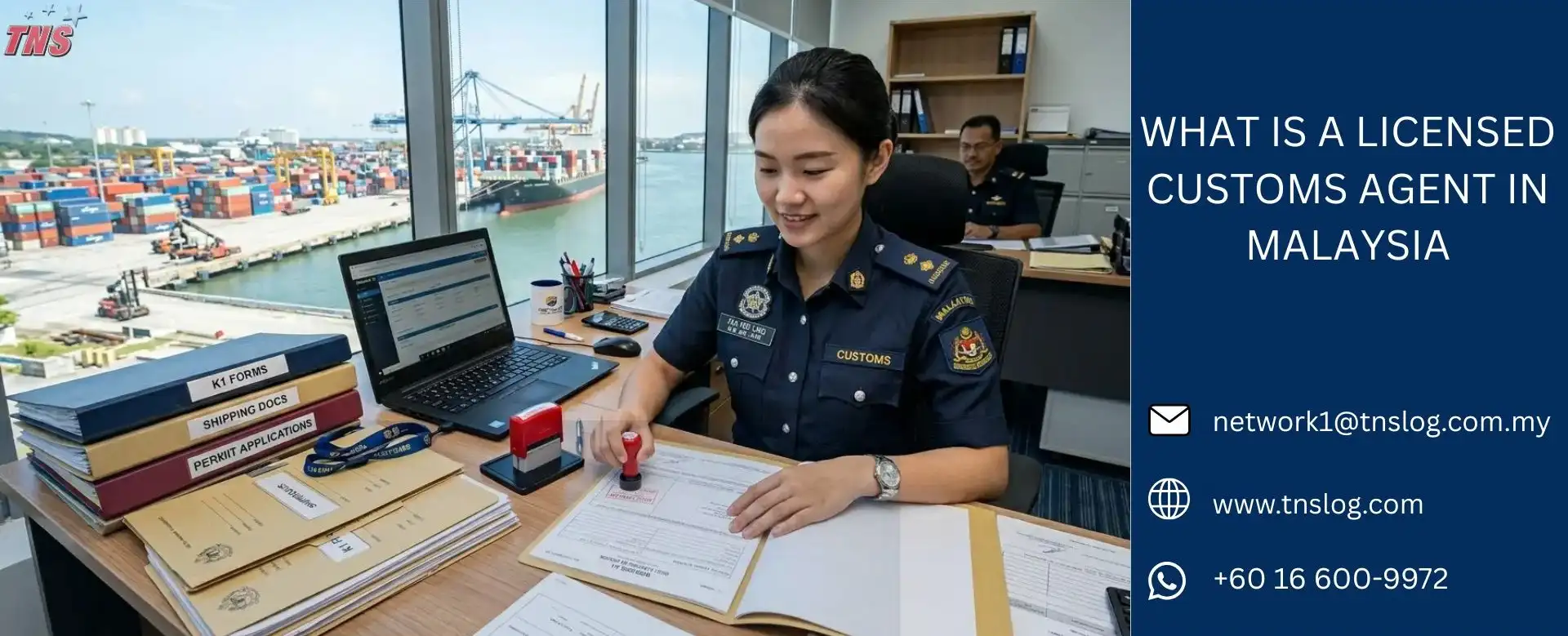
- Only a licensed customs agent can lodge your declaration. A forwarder without the licence subcontracts the filing and adds a margin.
- Ask for the licence number and the customs station — and check whose name appears on the filed declaration.
- Subcontracted clearance costs you on the bad days: slower answers to Customs queries, unclear responsibility, and demurrage while it is sorted out.
- TNS has held its own licence since 2014 and files in-house at Westport and Northport.
Licensed customs agent vs freight forwarder: the difference most shippers never ask about
Almost every freight forwarder in Malaysia will tell you they “handle customs
clearance”. Very few will tell you whether they hold the licence themselves.
The distinction matters because only a licensed agent can file the declaration.
A forwarder without a licence still quotes you for clearance — it simply subcontracts
the filing to a licensed broker and adds a margin. Your cargo passes through one more
company, one more handover and one more set of office hours before it reaches Customs.
This is not a small administrative detail. When a declaration is rejected, when
Customs raises a query on your HS code, or when your container is pulled for
inspection, the speed of the response depends on whether the person who filed it works
for the company you hired — or for someone your forwarder subcontracted to.
What the licence actually is
Customs agents in Malaysia are licensed under the Customs Act 1967 and regulated by
the Royal Malaysian Customs Department (Jabatan Kastam Diraja Malaysia, or JKDM). The
licence is issued to the company rather than to an individual, and declarations are
submitted electronically through the Customs system — which is precisely what an
unlicensed party cannot do on your behalf.
What matters commercially is simple: the licence is what gives a company
direct access to file. Everything else — rates, service, communication — sits
on top of that.
The four declaration forms, and who files them
- K1 — import declaration. Filed before your cargo can be released
from the port. - K2 — export declaration. Required before your cargo leaves
Malaysia; also the basis for a Certificate of Origin application. - K3 — movement of goods within Malaysia, including to and from
designated areas such as Labuan and Langkawi. - K4 — the cargo manifest, filed by the carrier or its agent rather
than by the shipper.
A licensed agent files these directly. An unlicensed forwarder collects your
documents, forwards them to a licensed party, and relays the result back to you.
How to verify that your agent is actually licensed
You are entitled to ask, and a licensed agent will answer without hesitation:
- Ask for the customs agent licence number and the customs station
it covers. A company that holds one will give it to you. - Ask who submits the declaration. The useful question is not “do
you handle customs” but “does your own staff file the K1, or do you pass it to
another company?” - Look at the declaration itself. The agent that filed your K1
appears on it. If the name on the form is not the company you hired, your clearance
was subcontracted. - Ask where their declarants sit. A team physically working at the
port handles a query in the same afternoon; one that is not, does not.
What actually goes wrong when clearance is subcontracted
Subcontracting is legal and extremely common. The issue is not legality — it is what
happens on the bad days:
- Slow response to Customs queries. An HS code question that could
be answered in an hour takes a day when it has to travel through two companies. - Unclear responsibility. When a declaration error causes a penalty
or a delay, the forwarder points at the broker and the broker points at the
documents you supplied. - Demurrage and detention. Free time at Port Klang is finite. Every
day lost inside the handover chain is a day billed by the shipping line — and
those charges accumulate faster than most shippers expect. - No single point of accountability. You end up coordinating between
parties you never contracted with.
What a licensed customs agent should be doing for you
Beyond filing the form:
- HS code classification — getting this right before the shipment
moves, not arguing about it after Customs disagrees. Misclassification is the most
common cause of both penalties and overpaid duty. - Duty and tax assessment — checking whether exemptions, preferential
rates under free trade agreements, or SST relief apply to your goods before you pay
the standard rate. - Document check before arrival — invoice, packing list, bill of
lading and permits reviewed while the vessel is still sailing, so problems surface
early. - Permits and controlled goods — identifying which agency approval
your product needs, and flagging it before the cargo is already sitting at the
port. - Handling inspections — attending the examination, resolving
discrepancies, and getting the release.
What clearance actually looks like, day by day
Most guides describe customs clearance as a single step. In practice it is a sequence,
and knowing where the time goes tells you where a shipment can be lost:
- Before arrival — the agent reviews the invoice, packing list and
bill of lading, confirms the HS code, checks whether any permit or agency approval
applies, and prepares the declaration. Work done here is what prevents delays
later. - On arrival — the declaration is submitted once the vessel and
manifest details are in the system. Anything inconsistent between the manifest and
the declaration stops the process here. - Assessment — Customs assesses the declaration. Straightforward
shipments with clean documents pass quickly; queries on classification, valuation
or origin are raised at this point. - Duty and tax payment — payable before release. Delays here are
usually about who authorises payment on the importer’s side, not about Customs. - Inspection, if selected — the container is moved for examination.
The agent attends, answers on the spot, and resolves discrepancies. - Release and haulage — the release is obtained and the container is
trucked out. Free time at the terminal is finite, so this step is where storage and
demurrage charges start if the earlier steps ran long.
Straightforward shipments with complete documents typically clear in one to three
working days. What stretches that is almost never Customs itself — it is a missing
permit, an inconsistent invoice, or a classification argument that should have been
settled before the vessel sailed.
The five things that most often hold a declaration up
- Wrong or disputed HS code. The single biggest cause of both
penalties and overpaid duty. Getting a second opinion before shipping costs
nothing; arguing after arrival costs storage. - Invoice that does not match the goods. Vague descriptions,
missing unit values, or a total that does not reconcile with the packing list. - A permit nobody checked for. Controlled goods need approval from
the relevant agency. This is discovered far too often after the container has
already landed. - Manifest and declaration disagreeing. Container numbers, weights
or piece counts that differ between the carrier’s manifest and your declaration. - Incomplete company records. Importer or exporter registration
details that are out of date will stop a filing before it starts.
What documents you need to give your agent
For a standard import: commercial invoice, packing list, bill of lading or air waybill,
and your company’s registration details. Add the certificate of origin if you are
claiming a preferential duty rate under a free trade agreement, and the relevant agency
permit if your goods are controlled. For an export: commercial invoice, packing list,
booking confirmation, and the permit or certificate of origin where applicable.
The documents people forget are the ones tied to a claim — the certificate of origin
for a preferential rate, or the exemption approval for relief. Without them at the time
of filing, you pay the standard rate, and recovering it afterwards is far harder than
getting it right the first time.
How customs agents charge
Charges are usually split into the agent’s declaration fee, the duty and tax paid to
Customs on your behalf, and third-party costs such as terminal handling, inspection and
haulage. The declaration fee is the part that varies between agents; the rest is largely
fixed by the port, the carrier and the tariff.
The number worth comparing is therefore not the clearance fee in isolation but the total
landed cost — and, just as importantly, what a delay costs you when something goes
wrong.
Choosing an agent: a short checklist
- Do they hold the licence themselves, or subcontract?
- Which customs stations are they licensed and physically present at?
- Can they also arrange the freight and the haulage, or only the paperwork?
- Who will you actually deal with day to day?
- How do they handle an inspection or a query — and can they give you an example?
- How long have they held the licence?
Send us your cargo details and we will tell you which declarations and permits it needs — filed by our own licensed declarants at Port Klang, not passed to a third party.
Frequently Asked Questions
How do I verify a customs agent’s licence in Malaysia?
Ask the company directly for its customs agent licence number and the customs station
it covers. You can also check the declaration itself once filed — the agent that
lodged it is named on the form. If that name is not the company you hired, your clearance
was subcontracted.
What is the difference between a customs agent and a freight forwarder?
A freight forwarder arranges transport. A licensed customs agent is authorised to lodge
declarations with Customs. Many forwarders are not licensed agents and subcontract the
filing; some, including TNS, hold both roles in one company.
Can I declare my own shipment without a customs agent?
Companies can register to declare for themselves, but in practice almost all importers
and exporters appoint a licensed agent — the classification, valuation and permit
requirements are where mistakes become expensive, and an agent that files daily catches
them before submission.
What happens if I use an unlicensed agent?
An unlicensed party cannot file for you at all, so it must pass your shipment to
someone who can. That is legal, but it adds a handover to every step — including
the steps that matter most, such as responding to a Customs query or attending an
inspection.
What documents does a licensed customs agent handle?
The declaration itself (K1 for imports, K2 for exports, K3 for movements within
Malaysia), plus the supporting set: commercial invoice, packing list, bill of lading or
air waybill, certificate of origin where a preferential rate is claimed, and any agency
permit required for controlled goods.
How long does customs clearance take in Malaysia?
Straightforward shipments with complete documents typically clear in one to three
working days. Delays are usually caused by a disputed HS code, a missing permit, or
documents that do not reconcile — not by Customs itself.
Why this is how TNS is set up
TNS Log Services has held its own customs agent licence since 2014 and operates daily
at Westport and Northport in Port Klang. Declarations are prepared and filed by our own
declarants, not passed to a third party — which means when Customs raises a query, the
person who answers it works here.
Because we also arrange the ocean freight, the haulage and the warehousing, one
company is accountable from booking to delivered container. For shippers who have spent
a season chasing three suppliers for one shipment, that is usually the point.
See our customs
clearance services, or
message us on WhatsApp and tell us what you are shipping — we will tell you which
declarations and permits it needs before you book.