
proves where your goods were made. There are two kinds: a preferential CO, which
lets your buyer pay a lower or zero import duty under a free trade agreement, and a
non-preferential CO, which simply states origin. In Malaysia it is applied for
after the K2 export declaration — so if the declaration is wrong, the certificate
inherits the error.
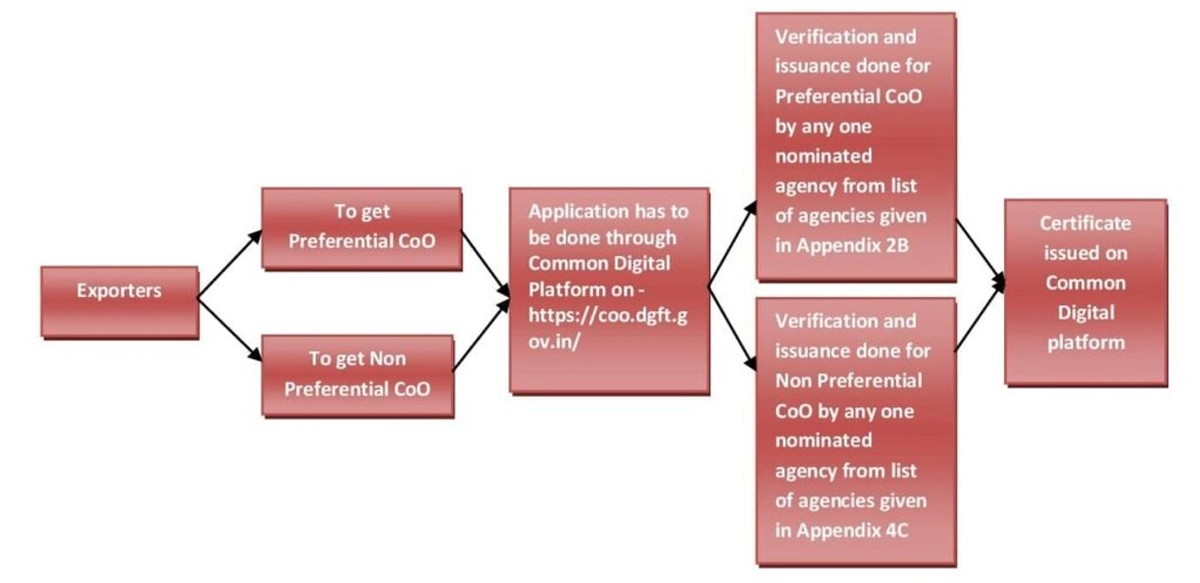
- Two kinds: preferential (lowers your buyer’s import duty under an FTA) and non-preferential (states origin only).
- Ask your buyer which form and which agreement — Form D, E, AK, AJ, AI, AANZ and RCEP are not interchangeable.
- It is applied for after the K2 declaration, so any error upstream flows into the certificate.
- Assembling imported components in Malaysia does not automatically make goods Malaysian origin. Check the rule before promising a preferential CO.
Why your buyer keeps asking for one
A Certificate of Origin is not paperwork for its own sake. Under a free trade
agreement, your buyer’s customs authority will charge a reduced or zero import duty on
goods that qualify as Malaysian origin — but only if the right certificate is presented.
That saving belongs to your buyer, not to you. Which is exactly why it matters
commercially: a supplier who reliably provides the correct CO is cheaper to buy from than
one who does not, even at the same unit price. Exporters who treat it as an afterthought
lose repeat orders to ones who do not.
Preferential vs non-preferential
- Preferential CO — used to claim a lower duty rate under an FTA.
The goods have to actually qualify under that agreement’s origin rules, and the
certificate is tied to a specific agreement and form. - Non-preferential CO — states the country of origin without any duty
claim. Buyers ask for it for customs formalities, tenders, letters of credit, or
import licensing in markets with no FTA in play.
The first question to your buyer is therefore not “do you need a CO?” but
“which one, and under which agreement?” The answer decides the form,
the origin criteria you have to meet, and how much lead time you need.
The forms, and which market each belongs to
Preferential certificates are issued against a specific agreement. The ones Malaysian
exporters meet most often:
- Form D — ASEAN member states, under ATIGA.
- Form E — China, under the ASEAN–China FTA.
- Form AK — Korea. Form AJ — Japan.
Form AI — India. Form AANZ — Australia and
New Zealand. - RCEP — a separate certificate covering the RCEP member states,
which sometimes gives a better outcome than the older bilateral agreement for the
same destination.
Where two agreements cover the same country, they are not interchangeable — the duty
outcome and the origin rules can differ. It is worth asking your buyer which one their
broker intends to claim under before you apply.
Where it sits in the export sequence
- Booking confirmed, cargo prepared.
- K2 export declaration filed by your licensed customs agent.
More
on the K2 form. - Cargo gated in and shipped; bill of lading issued.
- CO applied for, referencing the export declaration and the
shipping documents. - Certificate sent to the buyer with the rest of the document set.
Because the certificate is built on the declaration, anything wrong upstream shows up
downstream. A description that does not match, a weight that disagrees with the packing
list, or a classification the buyer’s customs disputes will all surface at the worst
possible moment — when your buyer is trying to clear the cargo.
Do your goods actually qualify?
A preferential CO is a claim that the goods originate in Malaysia under that
agreement’s rules. Broadly, goods qualify if they are wholly obtained here, or if
imported inputs have been transformed enough to meet the agreement’s origin criteria —
usually expressed as a change in tariff classification or a minimum local value content.
This is where exporters get caught. Assembling imported components in Malaysia does
not automatically make the finished product Malaysian for FTA purposes. If a meaningful
share of your inputs is imported, confirm the origin criteria before you promise
your buyer a preferential certificate — not after they have already priced the order on
the assumption of a lower duty.
What goes wrong
- Asked for too late. Applying after the documents have gone out
turns a routine step into an amendment. - Wrong form. Issued under the wrong agreement, it is refused at the
buyer’s end and has to be redone. - Details that do not match. Consignee, description, quantity and
weight have to agree across the invoice, the declaration and the certificate. - Origin assumed rather than checked. The most expensive version:
the buyer claims a preferential rate, their customs disagrees, and they are
assessed the full duty plus a penalty. - Nobody owns it. The exporter assumes the forwarder is handling it;
the forwarder assumes the exporter is.
Tell us the destination and what you are exporting. We will confirm which form applies, whether your goods meet the origin rules, and handle the application with the K2 as one file.
Frequently Asked Questions
Who issues a Certificate of Origin in Malaysia?
Preferential certificates are issued by the government body administering trade
agreements; non-preferential certificates are commonly issued by chambers of commerce.
Which route applies depends on the type of certificate your buyer needs.
When do I apply for the CO?
After the K2 export declaration, because the application references it. In practice
the application is prepared alongside the export file so that the certificate is ready
close to the sailing date.
Can I get a CO after the shipment has left?
It is normally applied for around the time of shipment. Applying well after the fact is
possible in some cases but adds friction and delay — and your buyer usually needs it
before the cargo arrives at their port.
What is the difference between Form D and Form E?
Form D covers trade between ASEAN member states under ATIGA. Form E covers exports to
China under the ASEAN–China agreement. Different destinations, different origin
rules — they are not interchangeable.
Does a Certificate of Origin reduce my costs as the exporter?
Not directly — the duty saving is on your buyer’s side. Commercially it still
matters to you, because it makes buying from Malaysia cheaper for them than buying from a
country without that agreement.
Getting the CO handled with the export, not after it
TNS Log Services has held its own customs agent licence since 2014. We file the K2,
prepare the Certificate of Origin application from the same document set, and check the
details agree before anything is submitted — so the certificate matches the
declaration and the buyer clears without a query.
See the full export
process, or
message
us on WhatsApp with your destination and product — we will tell you which form
applies and whether your goods qualify before you commit to your buyer.