
need a registered company, a customs declaration (K1) filed by a licensed customs agent,
the right HS code, any permit your goods require, and payment of duty and SST before the
container is released. Most of the delays first-time importers hit are caused by
paperwork prepared after the vessel sailed rather than before.
- You need a registered Malaysian company and a licensed customs agent — only a licensed agent can lodge your K1 declaration.
- Duty and SST are calculated on the CIF value, so freight and insurance feed straight into your tax bill.
- Send documents to your agent before the vessel sails. Problems found early cost nothing; found on arrival they cost storage.
- Most delays come from a vague invoice, a supplier-supplied HS code, or a permit nobody checked for.
Before you import anything
Two things have to exist before a shipment moves:
- A registered Malaysian company. Imports are declared under a
company, not a person. Your company registration details go on the declaration and
have to be current — out-of-date records stop a filing before it starts. - A licensed customs agent. Only a company licensed by the Royal
Malaysian Customs Department can lodge your declaration. If your freight forwarder
does not hold that licence, it subcontracts the filing to someone who does.
How to
verify a licensed customs agent is worth reading before you appoint one.
The import process, step by step
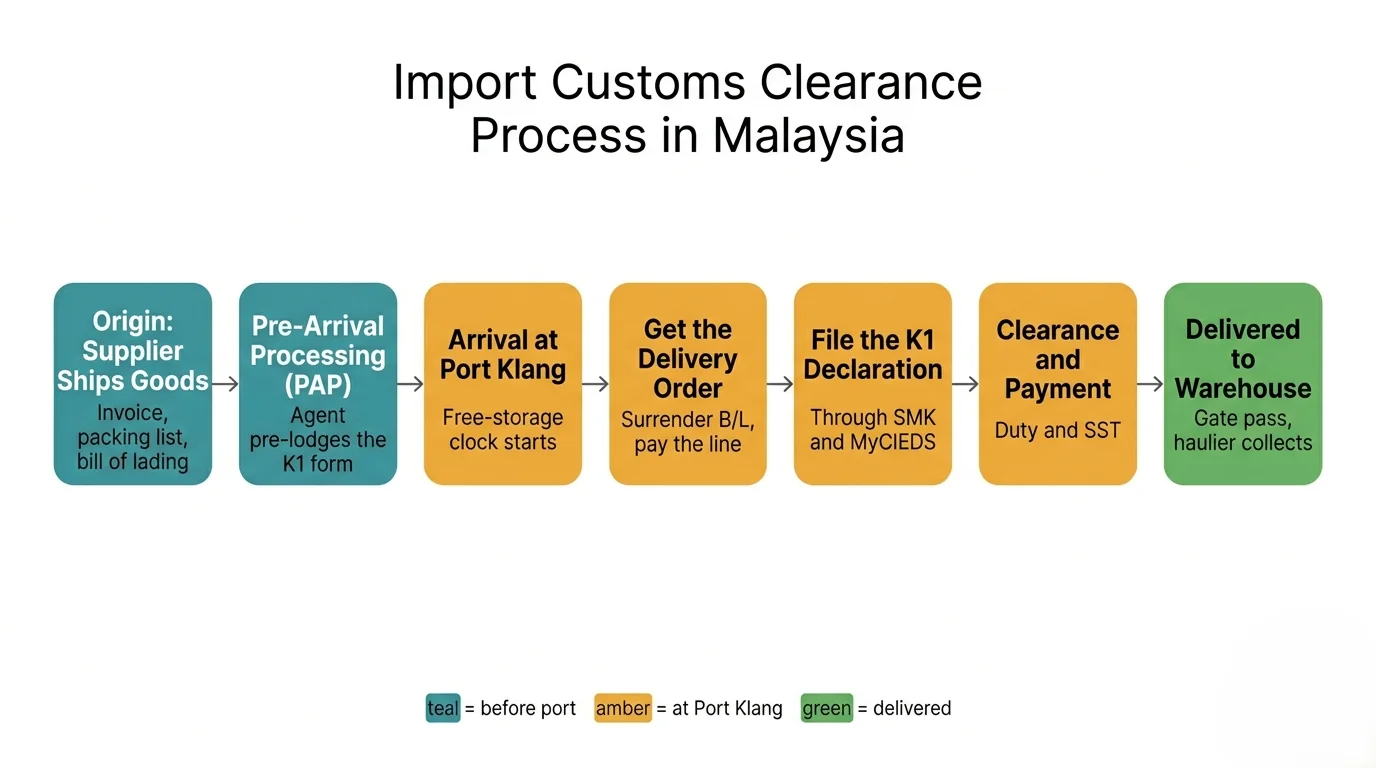
- Agree Incoterms with your supplier. This decides who arranges and
pays for what. Under FOB you control the freight from the origin port; under CIF
your supplier books it and you inherit whatever they chose. - Book the freight. Full container (FCL) if you have the volume,
LCL if you do not, air if the value-to-weight ratio justifies it. - Send documents to your agent early. Commercial invoice, packing
list and bill of lading. This is the step that decides whether clearance is quiet
or expensive — an HS code or permit problem found now costs nothing, found on
arrival it costs storage. - Declaration is filed. Your agent lodges the K1 once the vessel and
manifest details are in the system. - Assessment. Customs assesses the declaration. Clean documents pass
quickly; questions on classification, valuation or origin are raised here. - Pay duty and SST. Payable before release. Delays at this step are
almost always about internal approval on the importer’s side. - Inspection, if selected. The container is moved for examination and
your agent attends. - Release and delivery. The container is trucked out. Free time at
the terminal is finite — this is where storage and demurrage start if the
earlier steps ran long.
Documents you will need
- Commercial invoice — with a clear description, quantities and
unit values that reconcile with the packing list. - Packing list — pieces, weights and dimensions.
- Bill of lading or air waybill.
- Certificate of origin — only needed if you are claiming a
preferential duty rate under a free trade agreement, but without it at the time of
filing you pay the standard rate. - Permit or agency approval — for controlled goods.
- Company registration details.
How your landed cost is actually built up
New importers usually budget for the goods and the freight, then get surprised by the
rest. A realistic landed cost has four layers:
- Goods — what you pay the supplier.
- Freight and origin charges — ocean or air freight, plus
whatever the supplier’s side bills under your Incoterm. - Duty and tax — import duty where applicable, plus sales tax.
Both are calculated on the CIF value, not on the goods value alone, which is why
freight and insurance costs feed directly into your tax bill.
How CIF value is
calculated explains the arithmetic. - Destination charges — terminal handling, customs agent fee,
haulage, and anything triggered by delay: storage, demurrage, detention.
Permits and controlled goods
Plenty of ordinary commercial products need approval from an agency before they can
be imported — food, health products, telecommunications equipment, certain
construction materials, and anything with a safety or standards regime attached. The
permit is tied to the goods, not to your company, so a product you have never imported
before may need one even though your last ten shipments did not.
The practical rule: tell your agent exactly what the goods are, in plain language,
before you place the order. Not the HS code you assume applies — the actual
product. Identifying a permit requirement while the cargo is still at origin is an
inconvenience; discovering it after arrival means storage charges while you apply.
What goes wrong for first-time importers
- The supplier’s invoice is too vague. “Machine parts” is not a
description Customs can classify. This is the single most common cause of
queries. - The HS code came from the supplier. Your supplier classifies for
their export, not your import. The code that matters is the one accepted in
Malaysia. - CIF terms with no visibility. Your supplier books the freight,
picks the carrier and the destination agent, and you find out about the charges
when you are invoiced for them. - No one watched the free time. Container free time runs from
discharge whether or not your paperwork is ready. - Certificate of origin arrived late. Claiming a preferential rate
after the declaration is filed is far harder than claiming it at the time.
Tell us what you are bringing in and where from. We will confirm the HS code, flag any permit you need, and quote the freight and clearance together — before you place the order.
Frequently Asked Questions
Do I need a licence to import into Malaysia?
You need a registered company, and specific goods need permits from the relevant
agency. The customs licence itself is held by your agent, not by you — that is who
files the declaration on your behalf.
How long does import clearance take?
Straightforward shipments with complete documents typically clear in one to three
working days. What stretches it is a disputed classification, a missing permit, or
documents that do not reconcile.
Can I clear my own import?
In practice almost every importer appoints a licensed agent. Classification, valuation
and permit requirements are where mistakes turn expensive, and an agent that files daily
catches them before submission rather than after.
What is the difference between FOB and CIF when importing?
Under FOB you take over at the origin port and control the freight, the carrier and
the destination charges. Under CIF your supplier arranges it and you inherit their
choices. FOB gives more control over cost; CIF is simpler if you are starting out.
What is charged on top of the goods and freight?
Import duty where applicable and sales tax, both calculated on the CIF value, plus
terminal handling, the customs agent’s fee and haulage. Storage, demurrage and detention
are added only if the shipment is delayed.
Importing through Port Klang
TNS Log Services has held its own customs agent licence since 2014 and works daily at
Westport and Northport. Because we arrange the ocean freight, file the declaration and
run the haulage, one company is accountable from booking to delivered container —
and when Customs raises a query, the person who answers it works here.
See our customs
clearance services, or
message
us on WhatsApp with what you are importing and where from — we will tell you
which declarations and permits it needs before you place the order.