
Quick answer: To clear customs at Port Klang, your licensed agent files a K1 declaration through the SMK system, uploads your documents via MyCIEDS, and pays import duty plus SST to the Royal Malaysian Customs Department (RMCD) before a release order is issued. With accurate documents and Pre-Arrival Processing lodged before the vessel berths, a clean shipment clears in one to three working days. Missing or mismatched documents stall the process and eat into your free-storage period.
Customs Clearance Process in Port klang: Complete Guide 2026
Quick Answer :
The import customs clearance process in Malaysia involves declaring your goods to the Royal Malaysian Customs Department (RMCD), paying import duty and SST, then getting a release order before your cargo leaves the port. Your licensed agent files a K1 declaration through the SMK system and uploads the documents through MyCIEDS. Customs checks your HS code and declared value, you pay, and the goods are released. At Port Klang in 2026, a clean shipment can be cleared within one to three working days if your documents are accurate.
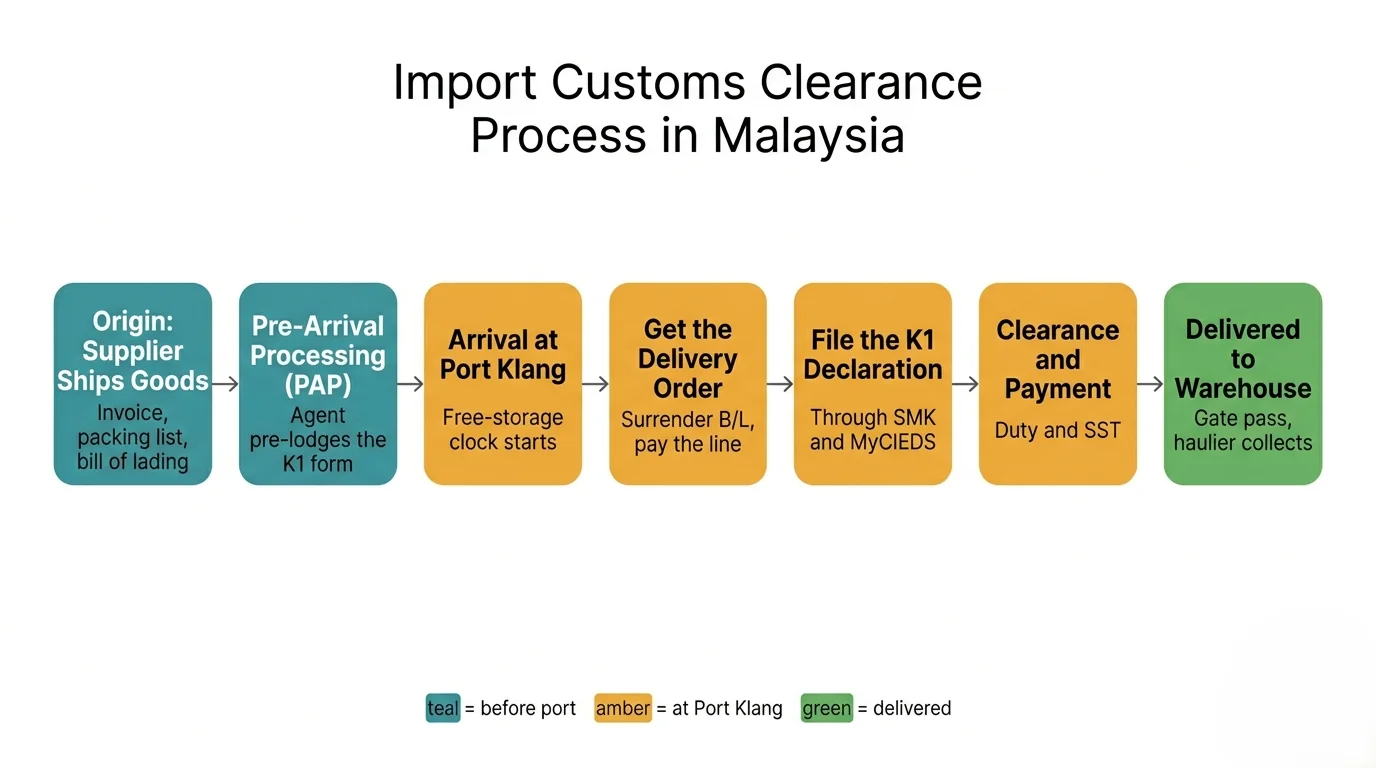
The whole process at a glance:
- Prepare your documents — invoice, packing list, bill of lading, and any permits.
- Pre-Arrival Processing (PAP) — your agent pre-lodges the K1 before the ship berths.
- Vessel arrives — your container is discharged and your free-storage clock starts.
- Get the Delivery Order — surrender the original bill of lading and pay the shipping line.
- File the K1 — submitted through SMK, with documents uploaded via MyCIEDS.
- Assessment and payment — customs confirms your HS code and value, then you pay duty and SST.
- Release and delivery — the release order issues, and your haulier trucks the cargo out.
What Documents Do You Need to Import into Malaysia?
Bringing goods into Malaysia is not as simple as waiting for the ship to arrive and collecting your cargo. Every import must pass through RMCD. They are the gatekeepers. Until your goods are declared, your taxes are paid, and a release order is issued, your container stays locked inside the port. The whole process involves many parties: your overseas supplier, the shipping line, your licensed forwarding agent, RMCD, the port terminal, and finally the haulier who trucks your cargo out.
Import customs clearance runs on documents. Each one carries a piece of the story, and customs only releases your goods when every piece matches. So before anything else, you need this set ready:
- Commercial Invoice — shows the goods, the value, and the buyer and seller. Customs uses it to assess your duty and tax.
- Packing List — the quantity, weight, and how each item is packed.
- Bill of Lading (sea) or Air Waybill (air) — proof of shipment and your title to the goods.
- Booking Confirmation — issued by the shipping line or forwarder when you book space.
- Proof of Payment — a bank slip or remittance that backs up your declared value.
- Certificate of Origin — Form E for China or Form D for ASEAN, to claim lower duty under a free trade agreement.
- Insurance Certificate — part of your CIF value.
- Delivery Order (D/O) — lets you collect the cargo from the terminal.
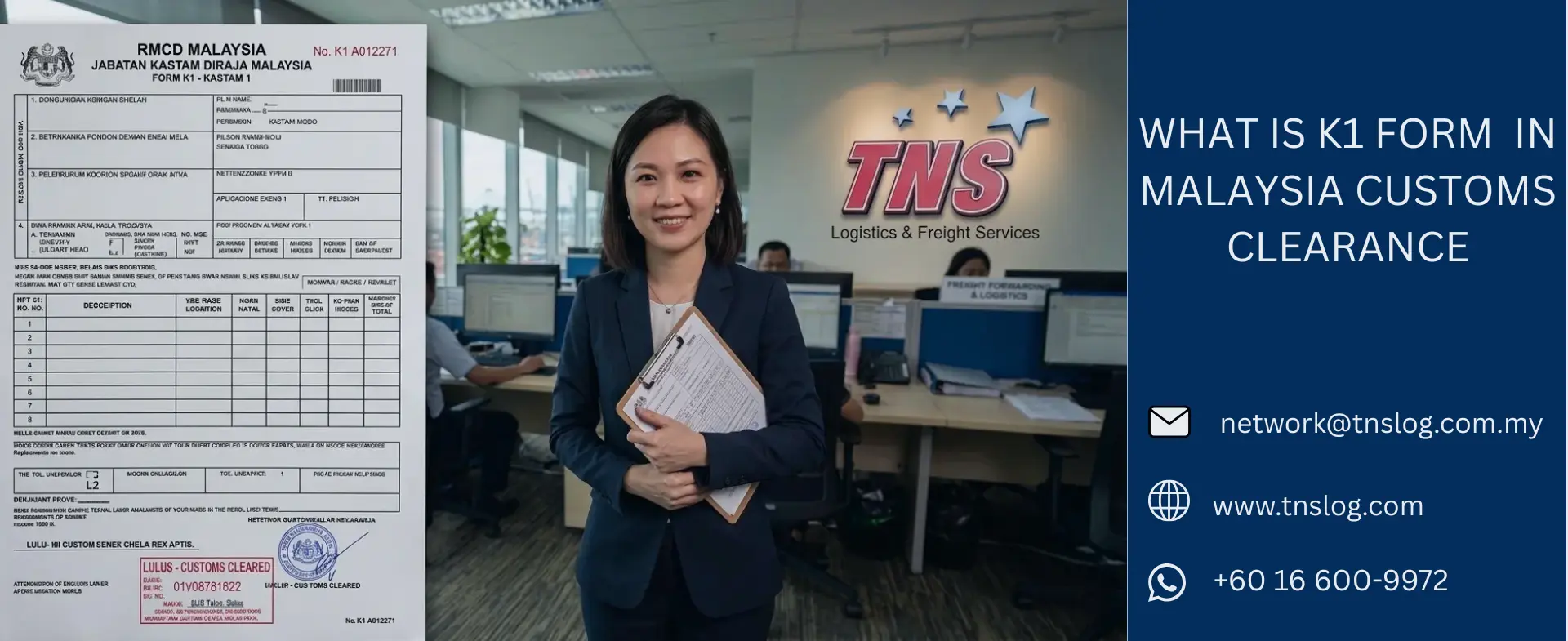
- K1 Import Declaration (Borang Kastam No. 1) — the official customs form for every import.
- Self-billed e-Invoice — required in 2026 for every foreign purchase.
- Permits, if controlled — SIRIM for electronics, quarantine certificates for food, plants, or animals, and Approved Permits for vehicles.
The Step-by-Step Customs clearance Process at Port Klang
Step 1: Before the Ship Sails — Prepare Your Documents
It begins before the ship even sails. Your supplier prepares the commercial invoice and packing list the moment your order is confirmed. You book space, and the line or forwarder sends a booking confirmation. When the goods are loaded, the shipping line issues the Bill of Lading. This is the single most important shipping document, because whoever holds the original controls the cargo. If you import from China and want lower duty, your supplier also arranges a Form E at this stage. If you leave it out, you lose the savings completely.
Step 2: While the Vessel Is at Sea — Pre-Arrival Processing (PAP)
While the vessel is still at sea, the real work starts on your side. The shipping line sends a Notice of Vessel Arrival with the charges due. Your agent gathers the full document set and checks that the invoice, packing list, and Bill of Lading all agree on quantity, value, and weight. Any mismatch here may result in a customs hold later. A sharp agent prepares the K1 import form now and pre-lodges it before the vessel berths. This is called Pre-Arrival Processing (PAP), and it helps align your cargo release with the free-storage period. You also raise your self-billed e-invoice, so your tax records match afterwards. Getting your declared value right matters too, so learn how to calculate the CIF value before you file.
Step 3: The Vessel Arrives at Port Klang — The Free-Storage Clock Starts
The vessel arrives at Port Klang and your container is discharged at Westport or Northport. Port Klang handles a large portion of Malaysia’s container trade, so the yard moves fast and nothing waits for you. The most important clock starts right now. Your free storage runs for only about four days from discharge, not from when you start clearance. After that, demurrage begins, often RM150 to RM400 per container each day. This gap between discharge and trucking out is the real enemy, far more than customs itself. Air freight follows the same path but moves faster — your goods arrive at the KLIA Air Cargo Complex under an Air Waybill, and clean shipments often clear in two to three days.
Step 4: Get the Delivery Order and File the K1 Declaration
To take the container, you first need the Delivery Order. Your agent surrenders the original Bill of Lading to the shipping line and settles their charges.The shipping line then issues the D/O, which authorises the terminal to hand over your container. In parallel, your agent files the customs declaration. The K1 is submitted electronically through the SMK system via Dagang Net’s National Single Window, and the supporting documents are uploaded through the MyCIEDS platform, the mandatory document channel from 2026.
Step 5: The System Assigns a Clearance Lane (Green, Yellow, or Red)
Once the declaration has been submitted, the system decides how thoroughly your shipment should be inspected. Green Lane means automated clearance with minimal checks. Yellow Lane means your documents are verified before release. Red Lane means a physical inspection of both the goods and the paperwork. A clean, consistent document set keeps you in the green. Most holds come down to a few avoidable mistakes: a value that does not match across documents, a wrong HS code, a missing import permit, or a late Delivery Order. Each one stops your cargo, and each day on hold can add another RM150 to RM400 in demurrage.
Step 6: Customs Assesses Duty and Sales Tax
A customs officer then assesses the declaration. They confirm your HS code, check the declared value against reference databases, and verify your permits. From this, they calculate the import duty and the Sales Tax you owe. For example, consider an SME importing furniture through Westport. The CIF value is RM100,000 with 5% import duty, so duty adds RM5,000. Sales Tax at 10% then applies on RM105,000, which is RM10,500. The trader pays RM15,500 in total before release. A valid Form E can cut the duty portion to zero. Our full guide on SST on imports breaks down the current rates.
Step 7: Pay the Duty and SST
Next comes payment. Duty and SST must be settled before the goods are released,via counter payment, bank transfer, or electronic payment. In practice your agent usually advances these charges and bills you afterwards, so the container is not held up over a payment delay. The moment payment clears, the system issues the customs release order.
Step 8: Collect and Deliver the Container
The final stage is physical movement. The terminal issues a gate pass and a transport order to the haulier, who collects the container and delivers it to your warehouse. Your D/O and gate pass together prove you have the authority to remove the cargo. With everything timed well, a sea shipment clears and reaches your door within about three to five business days, and clean, non-controlled cargo can release in one to three working days.
Step 9: After Delivery — Keep Your Records
After delivery, the job is not quite over. Keep every document — invoice, K1, payment receipt, permits — on file. RMCD can audit you later, and your customs receipt is what defends your import cost and your tax claim.
Common Pitfalls That Cost Businesses Money
After years of working the Port Klang ecosystem, these are the mistakes we see most often — and they are all avoidable.
The 4 Most Expensive Mistakes at Port Klang
1 Wrong HS Code Classification Using a generic or estimated code to reduce duty is a serious compliance risk. RMCD’s database flags it immediately, leading to audits, heavy fines, and in repeat cases, blacklisting.
2 Delayed SST Filing Waiting until your shipment is already at port to check your tax exemption status means you have already lost. Exemption applications can take 5–14 working days to approve.
3 No Demurrage & Detention Plan Westport and Northport grant only 3–5 free days. If your warehouse is not ready, or inland transport is not booked, demurrage charges start accumulating daily — and they escalate fast.
4 Incomplete Form K1 Missing or incorrect information on the K1 Import Declaration form is the number one reason cargo gets stuck at Northport. Every field matters
Import Duty Rate Malaysia — What Importers Must Know
Import duty is a government tax charged on goods entering Malaysia. The Royal Malaysian Customs Department (RMCD) calculates it on the CIF value of your shipment — meaning the combined total of your product cost, insurance, and freight.
Rates officially range from 0% to 60%, depending on the product’s HS Code. Raw materials and machinery typically fall at the lower end, while finished consumer goods, alcohol, and vehicles attract significantly higher rates.
Knowing your correct import duty rate Malaysia before your cargo ships helps you plan landed costs accurately — and avoids unexpected charges once your container reaches Port Klang
Frequently Asked Questions About Import Customs Clearance
Can I clear customs myself, or do I need a licensed agent?
By law, only a JKDM-licensed customs agent can file your import customs clearance declarations through the SMK system on your behalf. You may register and self-declare, but few SMEs have the access, time, or HS code knowledge. A licensed agent understands classification rules, permit requirements, and customs procedures thoroughly. Insider tip: choose an agent with staff physically at the port, because on-the-ground presence clears inspections far faster than remote filing.
How much does import customs clearance cost in Malaysia?
There is no single fixed cost, because it depends on your goods and shipment. You pay import duty and SST based on your HS code and CIF value, plus your agent’s clearance fee. Port charges, haulage, and any storage time add to the total. Some couriers also add a handling fee, often RM50 or around 3% of the duty and tax they advance. Insider tip: ask your agent for a full landed-cost estimate before you ship, so duty, tax, and fees never surprise you at the port.
Do I pay duty and tax on imports under RM500?
Often no, thanks to Malaysia’s de minimis rule. Goods with a CIF value of RM500 or below, shipped by air courier, can clear without import duty and SST. But this is not automatic, because customs can still inspect or revalue your parcel. Online purchases under RM500 may already carry a 10% Low-Value Goods tax at checkout, which is separate. Insider tip: this RM500 rule covers small parcels, not full container shipments.
Ready to Ship Through Port Klang?
TNS Log Services has held our own customs clearance licence since 2014. Our team operates daily at Westport and Northport in Port Klang every day, so we file early, clear fast, and keep your cargo well away from demurrage.We are strategically located near Port Klang for 24/7 support Send us your shipment details on WhatsApp at +60 16 600 9972 or through our contact page , and we will map your full clearance before the ship even berths.
You may also be interested in

Have Anything To Ask Us?
Please fill in your email in the form and we’ll get back to assist you soon!