
Quick answer: To avoid cargo seizure in Malaysia, importers must use the correct HS Code and obtain a CIDB Certificate of Approval (COA) if required. Without the CIDB COA, cargos like structural steel can get stuck at Port Klang, incurring demurrage and storage fees almost immediately.
HS Code Custom Malaysia with CIDB and COA: Avoid Cargo Seizure
By TNS Logistics | tnslog.com
A Real Story — Container Gets Stuck at Port Klang
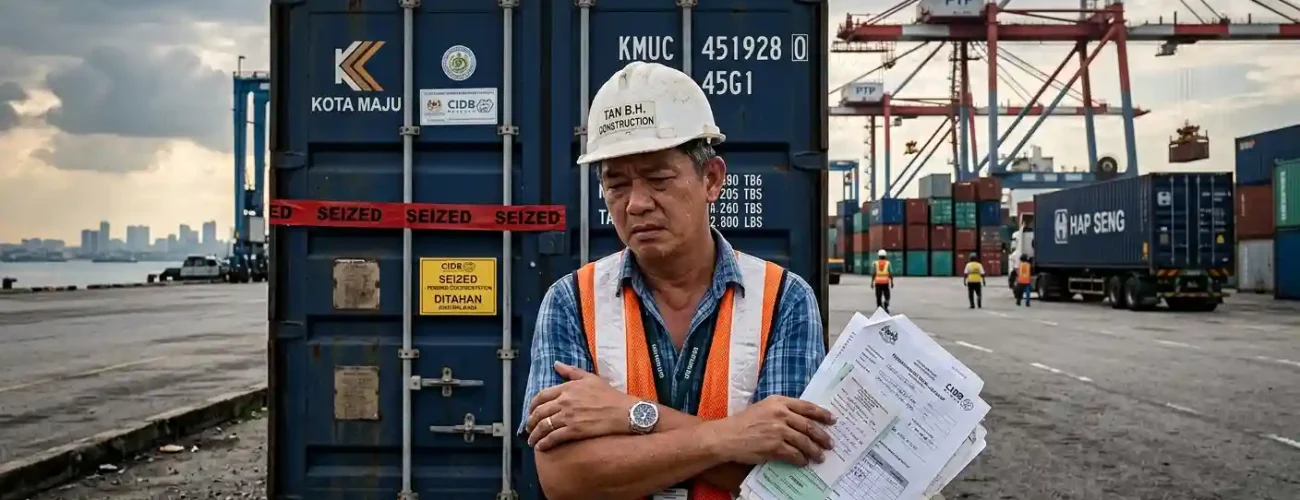
Everything seemed to be going according to plan.
A Malaysian construction company had ordered a full container of structural steel from Foshan, China. The supplier prepared the shipment, the container was loaded, and the vessel was already on its way to Malaysia.
At the construction site, the team was waiting for the materials so work could begin.
Then the phone rang.
It was their forwarding agent at Port Klang.
“Customs has held your cargo. Do you have a CIDB Certificate of Approval?”
The company had never heard of it.
They had a Mill Certificate from the factory in China and assumed that was enough to prove the quality of the steel. Unfortunately, Malaysian authorities require more than that.
Without a CIDB COA, the container could not be released.
Within days, port storage charges and demurrage fees started increasing. The construction schedule was delayed, and the contractor had to explain to the project owner why the materials were still stuck at the port.
Situations like this are more common than many importers realise.
In most cases, the issue actually starts much earlier — before the vessel even leaves China — with one step that is often overlooked.
you also can read : How Long Does Customs Clearance Take in Malaysia?
Malaysia Custom Tariff Code — The First Step Most Importers Skip
The HS Code (Harmonized System Code) is an international classification number used by customs authorities to identify products that enter or leave Malaysia.
Customs authorities rely on this code to determine several important things, including:
How much import duty applies to your product
Whether your product requires special permits or approvals
Which government department must clear the shipment
Whether CIDB approval is required
For companies importing construction materials from China — such as steel bars, tiles, cement, or structural profiles — identifying the correct HS Code is the first step.
If the HS Code is incorrect, the entire approval process can break down.
you also can read : Licensed Customs Agent in Malaysia
Why the HS Code Matters
To understand why this matters, consider a simple example.
Structural steel products fall under specific chapters in the Malaysian customs tariff schedule. Once customs identifies the correct HS Code, they immediately check whether the product appears on the CIDB Controlled Materials List.
If it does, the importer must provide a valid CIDB Certificate of Approval (COA) before the cargo can be released.
Without the correct HS Code, it becomes difficult to even begin the CIDB application process properly. The two are directly connected.
For more information on Malaysia customs requirements, see our related guide: SST Exemption Malaysia 2026 — B2B Importers Complete Guide.
you also can read : What Is K1 form in Malaysia Customs Clearance for Import
CIDB COA Explained — From a Freight Forwarder's Perspective
Once the correct HS Code has been confirmed and the product is identified as a controlled construction material, the next requirement is the CIDB Certificate of Approval (COA).
What is CIDB?
CIDB stands for the Construction Industry Development Board Malaysia, the government body responsible for regulating the quality and safety of construction materials used in the country.
They maintain a list of materials that require approval before they can be imported or used on construction sites in Malaysia.
What is COA?
COA stands for Certificate of Approval.
This certificate confirms that a construction product — in its finished form — meets Malaysian standards and is approved for use in the country.
Without this certificate, regulated construction materials cannot legally be cleared through Malaysian customs.
The Most Common Mistake: A Mill Certificate Is Not Enough
Many importers assume that a Mill Certificate from the factory is sufficient documentation.
This is a common misunderstanding.
A Mill Certificate only confirms the quality of the raw material during production at the steel mill. However, CIDB requires verification of the finished product itself, not just the raw material used to manufacture it.
This is where the steel importer in our story encountered a problem.
They had a Mill Certificate from the factory in Foshan, but CIDB required a Finish Product Test Report confirming that the actual steel bars being shipped met Malaysian standards.
These are two different documents.
you also can read : Sales and Service Tax on Imports in Malaysia
The Complete Import Compliance Journey for Malaysia
Importing construction materials into Malaysia involves several regulatory steps.
Before cargo can be legally cleared, importers generally need to complete the following process:
1. Identify the Correct Malaysia HS Code
Check the Malaysia customs tariff schedule. Confirm which chapter and heading applies to your specific product.
2. Check the CIDB Controlled Materials List
Not all construction materials require CIDB approval. However, steel products, certain tiles, and other structural materials are included in the controlled list.
3. Register the Company under CCPM
Companies must first register with CCPM (CIDB Centralised Construction Procurement Management) so CIDB can verify the importer as a legitimate participant in the construction industry.
4. Register through Dagang Net
Dagang Net is Malaysia’s official digital trade facilitation platform. CIDB applications and customs declarations are processed through this system.
If a company is not properly registered, customs clearance may not proceed.
5. Obtain a Finish Product Test Report
This test must be conducted on the actual finished product at the manufacturing site in China and certified by an internationally recognized body, such as SGS. A standard Mill Certificate from the factory is not accepted by CIDB as a substitute.
6. Apply for the CIDB COA
Once all documentation is ready — including CCPM registration, Dagang Net access, and the product test report — the importer can apply for the CIDB Certificate of Approval.
CIDB will review the application and advise on approval.
What If Your Project Timeline Is Urgent?
In reality, these registrations, tests, and approvals take time.
Construction projects, however, often work under tight schedules.
In the steel case mentioned earlier, the importer’s CIDB COA application was still in progress while the shipment was already arriving in Malaysia.
To prevent further delay, TNS Logistics stepped in and arranged clearance through a DDP (Delivered Duty Paid) model — handling the duties, approvals, and delivery while the importer continued completing their own approval process, ensuring the construction site did not go silent
Under a DDP model, TNS Logistics takes full responsibility for customs clearance, approvals, and delivery to the final destination — so the client focuses on their project, not the paperwork.

Frequently Asked Questions About Importing Materials to Malaysia
Q: What is a Malaysia Custom HS Code?
An HS Code is an internationally standardised number used to classify traded products. Malaysian customs use it to determine import duties, regulatory requirements, and whether approvals such as CIDB COA are required.
Q: Is a Mill Certificate enough for CIDB approval?
No. A Mill Certificate only confirms raw material quality. CIDB normally requires a Finish Product Test Report from an accredited testing body such as SGS.
Q: What is Dagang Net and why does it matter?
Dagang Net is Malaysia’s official digital trade facilitation platform. All COA applications must be processed through this system. If your company is not correctly registered on Dagang Net, customs will not release your cargo regardless of other documents.
Q: What happens if my cargo arrives at Port Klang without a CIDB COA?
Your shipment will be held by customs. You will face port storage fees and demurrage charges while you sort out the paperwork. In serious cases, the cargo can be seized or returned. This is why compliance must be arranged before the vessel departs China.
Q: How long does CIDB COA approval take?
It varies depending on completeness of documentation and CIDB processing times. It is not an overnight process. If your project timeline is urgent, speak to your freight forwarder about alternative solutions such as a DDP arrangement.
Q: Does TNS Logistics assist with CIDB COA applications?
Yes. TNS Logistics provides full end-to-end support — from verifying your HS Code, advising on CIDB requirements, coordinating SGS testing, registering on Dagang Net, and handling customs clearance at Port Klang. Contact us before your cargo ships from China.
Conclusion: Get It Right Before the Vessel Leaves China
The two most important things to confirm before shipping construction materials from China to Malaysia are simple: the correct Malaysia Custom HS Code and whether your product requires a CIDB COA.
If either of these is overlooked, your cargo may be held at Port Klang, resulting in storage costs, penalties, and project delays.
The importer in our story learned this the hard way. You do not have to.
TNS Logistics supports importers throughout the entire compliance process — from HS Code verification and CIDB COA applications to customs clearance at Port Klang — helping ensure shipments move smoothly and projects stay on schedule.
Need help verifying your HS Code or CIDB requirements? Contact TNS Logistics before your shipment leaves China.
Importing Construction Materials to Malaysia?
Confirm Your HS Code and CIDB COA First
TNS Logistics provides end-to-end compliance support for construction material imports — from tariff code verification to CIDB approvals and Port Klang clearance.

You may also be interested in


Have Anything To Ask Us?
Please fill in your email in the form and we’ll get back to assist you soon!